Login
Use this general-purpose Authentication block when a host already owns its identity backend. It validates the email and password locally, keeps the password in host-owned input with a show/hide action, reports a safe host failure, and leaves authentication, recovery and navigation to the host.
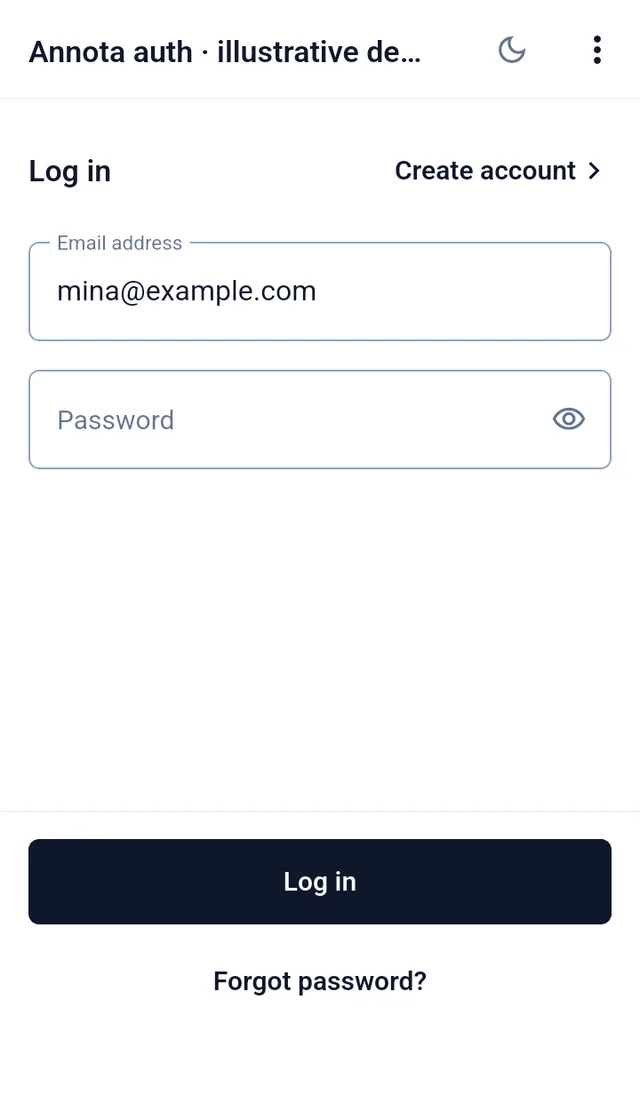
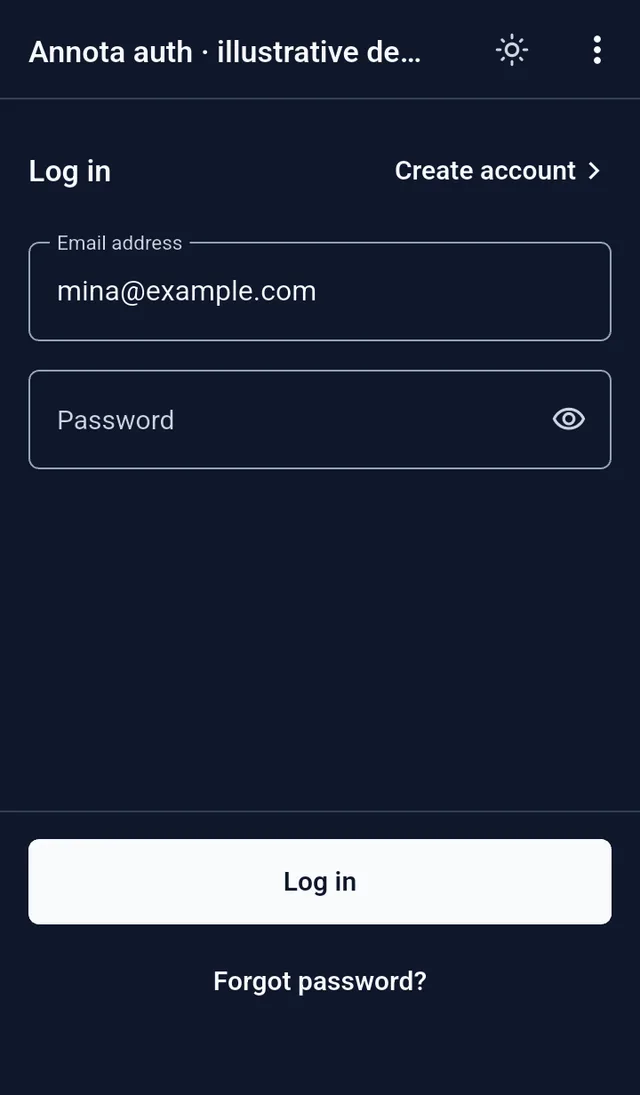
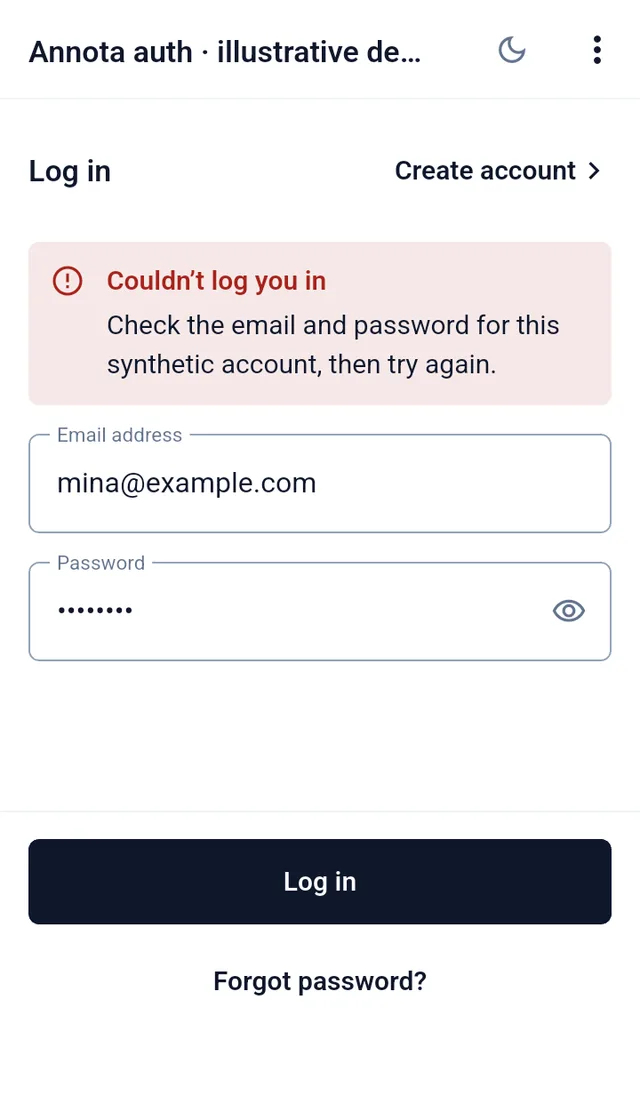
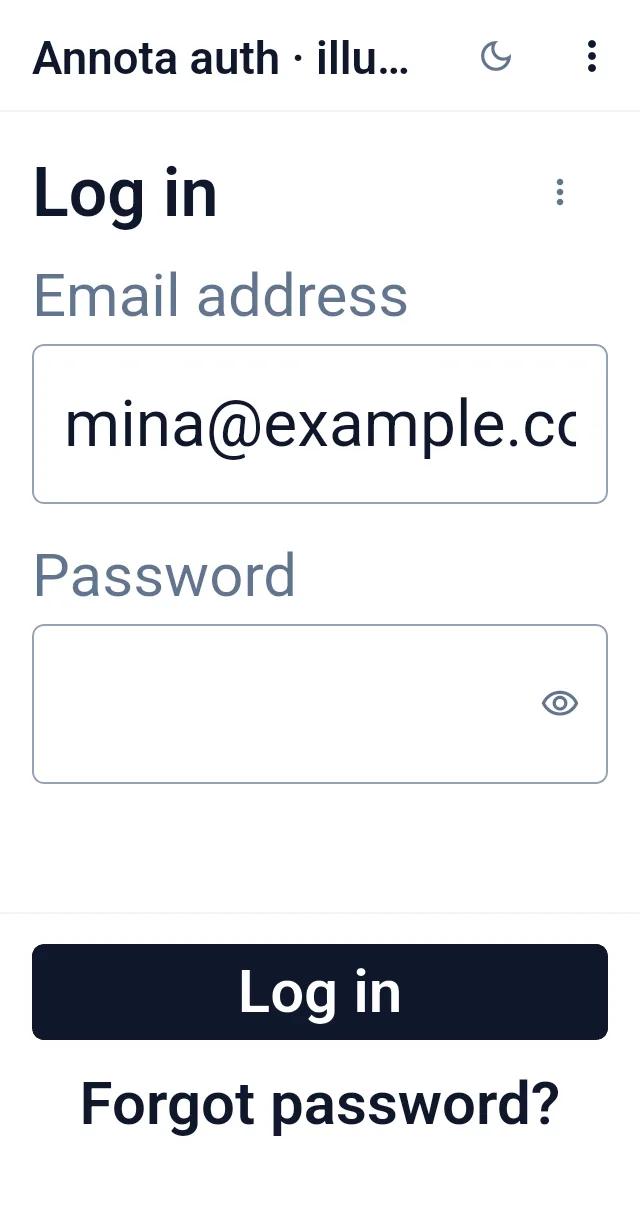
Run and try
Section titled “Run and try”From example/:
flutter run -d <device-id> -t lib/auth_blocks_demo.dartThe connected demo uses an Annota-derived illustrative host theme and synthetic
fixtures only. It is not Annota’s production authentication flow: nothing
leaves the device, no account is created or stored, and no secret is logged.
Use mina@example.com / notes123. The default scenario makes the first
sign-in fail so the recovery path is visible; the second succeeds and the host
navigates Home. The developer menu also starts the registration scenarios.
Composition and boundaries
Section titled “Composition and boundaries”LoginBlock is self-contained apart from the package. LoginCredentials is
the only value passed across the authentication boundary. The host supplies
onSubmit, onForgotPassword, onRegister, busy and a safe errorText.
The block never authenticates, stores, transmits or logs a credential.
| UI | Existing library surface |
|---|---|
| Phone and wide page layout, title navigation and pinned action | PaymentFullPageView |
| Email input and validation error presentation | PaymentTextField |
| Submit and recovery action states | PaymentButton |
| Host failure announcement | PaymentBanner |
| Registration navigation | PaymentLink |
The password control is deliberately host code inside the copied file. The kit does not accept secrets or provide a password-input mode (D1a); the host owns secret input, credential handling, rate limits, recovery and routing. Continue with Register for account creation and host-required verification.
Source
Section titled “Source”Source: compositions/login_block.dart
Open this file on GitHub. Copy and adapt it in your host app.
import 'package:flutter/material.dart';import 'package:flutter/semantics.dart';import 'package:rakit_ui/rakit_ui.dart';
/// Credentials sent to the host when the form is valid.@immutableclass LoginCredentials {  const LoginCredentials({required this.email, required this.password});
  final String email;  final String password;}
/// Copyable host composition: email/password login with local validation,/// show/hide password, host failure, recovery and registration navigation.////// The block never authenticates, stores or transmits credentials. [onSubmit]/// is the host's authentication boundary; the host also owns recovery and/// routing through [onForgotPassword] and [onRegister]. [busy] and/// [errorText] describe the host's current attempt.class LoginBlock extends StatefulWidget {  const LoginBlock({    super.key,    required this.onSubmit,    required this.onForgotPassword,    required this.onRegister,    this.initialEmail = '',    this.busy = false,    this.errorText,  });
  final Future<void> Function(LoginCredentials credentials) onSubmit;  final VoidCallback onForgotPassword;  final VoidCallback onRegister;  final String initialEmail;  final bool busy;
  /// Safe host message for the failed attempt. Never include the password.  final String? errorText;
  @override  State<LoginBlock> createState() => _LoginBlockState();}
class _LoginBlockState extends State<LoginBlock> {  final _formKey = GlobalKey<FormState>();  late final TextEditingController _email;  late final TextEditingController _password;
  @override  void initState() {    super.initState();    _email = TextEditingController(text: widget.initialEmail);    _password = TextEditingController();  }
  @override  void dispose() {    _email.dispose();    _password.dispose();    super.dispose();  }
  String? _validateEmail(String? value) {    final email = value?.trim() ?? '';    if (email.isEmpty) return 'Enter your email address.';    final valid = RegExp(r'^[^@\s]+@[^@\s]+\.[^@\s]+$').hasMatch(email);    return valid ? null : 'Enter a valid email address.';  }
  String? _validatePassword(String? value) =>      (value ?? '').isEmpty ? 'Enter your password.' : null;
  void _submit() {    FocusScope.of(context).unfocus();    if (!(_formKey.currentState?.validate() ?? false)) return;    widget.onSubmit(      LoginCredentials(email: _email.text.trim(), password: _password.text),    );  }
  @override  Widget build(BuildContext context) {    final theme = PaymentTheme.of(context);    return PaymentFullPageView(      title: 'Log in',      pageLink: PaymentLink(        label: 'Create account',        onPressed: widget.busy ? null : widget.onRegister,      ),      primaryAction: PaymentButton(        label: 'Log in',        busy: widget.busy,        busyLabel: 'Signing you in',        onPressed: widget.busy ? null : _submit,      ),      secondaryAction: PaymentButton(        label: 'Forgot password?',        variant: PaymentButtonVariant.quiet,        onPressed: widget.busy ? null : widget.onForgotPassword,      ),      child: Form(        key: _formKey,        child: Column(          crossAxisAlignment: CrossAxisAlignment.stretch,          spacing: theme.space(PaymentSpace.group),          children: [            if (widget.errorText != null)              PaymentBanner(                tone: StatusTone.danger,                title: 'Couldn’t log you in',                message: widget.errorText,                announce: true,              ),            PaymentTextField(              label: 'Email address',              controller: _email,              type: PaymentTextFieldType.email,              required: true,              enabled: !widget.busy,              validator: _validateEmail,              textInputAction: TextInputAction.next,              autofillHints: const [AutofillHints.username],            ),            LoginPasswordField(              label: 'Password',              controller: _password,              enabled: !widget.busy,              validator: _validatePassword,              autofillHint: AutofillHints.password,              textInputAction: TextInputAction.done,              onSubmitted: (_) => _submit(),            ),          ],        ),      ),    );  }}
/// Host-owned password input. The kit deliberately has no secret-input mode;/// a copied block keeps this control in host code.class LoginPasswordField extends StatefulWidget {  const LoginPasswordField({    super.key,    required this.label,    required this.controller,    this.enabled = true,    this.validator,    this.errorText,    this.autofillHint = AutofillHints.password,    this.textInputAction,    this.onSubmitted,  });
  final String label;  final TextEditingController controller;  final bool enabled;  final FormFieldValidator<String>? validator;  final String? errorText;  final String autofillHint;  final TextInputAction? textInputAction;  final ValueChanged<String>? onSubmitted;
  @override  State<LoginPasswordField> createState() => _LoginPasswordFieldState();}
class _LoginPasswordFieldState extends State<LoginPasswordField> {  bool _obscured = true;
  @override  Widget build(BuildContext context) {    final theme = PaymentTheme.of(context);    final type = PaymentType.of(context);    final labelAbove = PaymentType.isLarge(context);    final border = OutlineInputBorder(      borderRadius: theme.controlBorderRadius,      borderSide: BorderSide(color: theme.border),    );    final errorBorder = OutlineInputBorder(      borderRadius: theme.controlBorderRadius,      borderSide: BorderSide(color: theme.danger.foreground),    );    return Semantics(      label: labelAbove ? widget.label : null,      isRequired: true,      validationResult: widget.errorText == null          ? SemanticsValidationResult.none          : SemanticsValidationResult.invalid,      child: Column(        crossAxisAlignment: CrossAxisAlignment.stretch,        spacing: theme.space(PaymentSpace.inline),        children: [          if (labelAbove)            ExcludeSemantics(              child: Text(                widget.label,                style: type.label.copyWith(                  color: widget.enabled ? theme.textSecondary : theme.disabled,                ),              ),            ),          TextFormField(            controller: widget.controller,            enabled: widget.enabled,            obscureText: _obscured,            autocorrect: false,            enableSuggestions: false,            keyboardType: TextInputType.visiblePassword,            autofillHints: [widget.autofillHint],            textInputAction: widget.textInputAction,            onFieldSubmitted: widget.onSubmitted,            validator: widget.validator,            forceErrorText: widget.errorText,            style: type.input.copyWith(              color: widget.enabled ? theme.textPrimary : theme.disabled,            ),            decoration: InputDecoration(              labelText: labelAbove ? null : widget.label,              labelStyle: type.label.copyWith(                color: widget.enabled ? theme.textSecondary : theme.disabled,              ),              filled: true,              fillColor: theme.surface,              contentPadding: labelAbove                  ? EdgeInsetsDirectional.symmetric(                      horizontal: theme.space(PaymentSpace.group) - 4,                      vertical: theme.space(PaymentSpace.group),                    )                  : EdgeInsetsDirectional.fromSTEB(                      theme.space(PaymentSpace.group) - 4,                      theme.space(PaymentSpace.group) +                          theme.space(PaymentSpace.inline),                      theme.space(PaymentSpace.group) - 4,                      theme.space(PaymentSpace.block),                    ),              enabledBorder: border,              disabledBorder: border.copyWith(                borderSide: BorderSide(color: theme.outline),              ),              focusedBorder: border.copyWith(                borderSide: BorderSide(color: theme.accent, width: 2),              ),              errorBorder: errorBorder,              focusedErrorBorder: errorBorder.copyWith(                borderSide: BorderSide(                  color: theme.danger.foreground,                  width: 2,                ),              ),              errorStyle: type.caption.copyWith(color: theme.danger.foreground),              suffixIconConstraints: const BoxConstraints(                minWidth: 48,                minHeight: 48,              ),              suffixIcon: PaymentIconButton(                icon: _obscured                    ? Icons.visibility_outlined                    : Icons.visibility_off_outlined,                tooltip: _obscured ? 'Show password' : 'Hide password',                onPressed: widget.enabled                    ? () => setState(() => _obscured = !_obscured)                    : null,              ),            ),          ),        ],      ),    );  }}
Source: auth_blocks_demo.dart
Open this file on GitHub. Copy and adapt it in your host app.
import 'package:flutter/material.dart';import 'package:rakit_ui/rakit_ui.dart';
import 'block_demo_shell.dart';import 'compositions/login_block.dart';import 'compositions/register_block.dart';
void main() => runBlockDemo(const AuthBlocksDemo());
enum AuthDemoScenario {  signInFailsOnce,  registrationFailsOnce,  verificationRequired,  directAccount,}
enum _Route { login, register, recovery, policy, home }
const _fixtureEmail = 'mina@example.com';const _fixturePassword = 'notes123';const _fixtureCode = '248913';
/// Synthetic Annota-themed host connecting the generic Login and Register/// blocks. It is deliberately not Annota's production authentication flow:/// there is no backend, account store, email delivery or secret persistence.class AuthBlocksDemo extends StatefulWidget {  const AuthBlocksDemo({    super.key,    this.initialScenario = AuthDemoScenario.signInFailsOnce,    this.initialDark = false,    this.delay = const Duration(milliseconds: 600),    this.textScale,    this.initiallyRegister = false,  });
  final AuthDemoScenario initialScenario;  final bool initialDark;  final Duration delay;  final bool initiallyRegister;
  /// Optional fixed text scale for accessibility proof.  final double? textScale;
  @override  State<AuthBlocksDemo> createState() => _AuthBlocksDemoState();}
class _AuthBlocksDemoState extends State<AuthBlocksDemo> {  late bool dark = widget.initialDark;  late AuthDemoScenario scenario = widget.initialScenario;  late _Route route = widget.initiallyRegister ? _Route.register : _Route.login;  RegisterBlockStep registerStep = RegisterBlockStep.details;  String? loginError;  String? registerError;  String? recoveryMessage;  bool busy = false;  int generation = 0;  int signInAttempts = 0;  int registerAttempts = 0;  int recoveryVisits = 0;  String registeredEmail = _fixtureEmail;
  void reset(AuthDemoScenario next) => setState(() {    generation++;    scenario = next;    route = _Route.login;    registerStep = RegisterBlockStep.details;    loginError = null;    registerError = null;    recoveryMessage = null;    busy = false;    signInAttempts = 0;    registerAttempts = 0;    recoveryVisits = 0;    registeredEmail = _fixtureEmail;  });
  void open(_Route next) {    if (next != route) FocusScope.of(context).unfocus();    setState(() {      route = next;      loginError = null;      registerError = null;      if (next == _Route.recovery) {        recoveryVisits++;        recoveryMessage = null;      }    });  }
  void abandonRegistration() {    FocusScope.of(context).unfocus();    setState(() {      route = _Route.login;      registerStep = RegisterBlockStep.details;      registerError = null;      registeredEmail = _fixtureEmail;    });  }
  Future<void> signIn(LoginCredentials credentials) async {    if (busy) return;    final current = generation;    signInAttempts++;    setState(() {      busy = true;      loginError = null;    });    await Future<void>.delayed(widget.delay);    if (!mounted || current != generation) return;    setState(() {      busy = false;      final failFirst =          scenario == AuthDemoScenario.signInFailsOnce && signInAttempts == 1;      final wrongFixture =          credentials.email != _fixtureEmail ||          credentials.password != _fixturePassword;      if (failFirst || wrongFixture) {        loginError =            'Check the email and password for this synthetic account, then try again.';        return;      }      route = _Route.home;    });  }
  Future<void> register(RegisterSubmission submission) async {    if (busy) return;    final current = generation;    registerAttempts++;    setState(() {      busy = true;      registerError = null;      registeredEmail = submission.email;    });    await Future<void>.delayed(widget.delay);    if (!mounted || current != generation) return;    setState(() {      busy = false;      if (scenario == AuthDemoScenario.registrationFailsOnce &&          registerAttempts == 1) {        registerError =            'The illustrative host could not create the account. Nothing was saved; try again.';        return;      }      if (scenario == AuthDemoScenario.verificationRequired) {        registerStep = RegisterBlockStep.verification;      } else {        route = _Route.home;      }    });  }
  Future<void> verify(String code) async {    if (busy) return;    final current = generation;    setState(() {      busy = true;      registerError = null;    });    await Future<void>.delayed(widget.delay);    if (!mounted || current != generation) return;    setState(() {      busy = false;      if (code != _fixtureCode) {        registerError =            'That code does not match the synthetic message. Use $_fixtureCode or resend it.';        return;      }      route = _Route.home;    });  }
  Future<void> resendCode() async {    if (busy) return;    final current = generation;    setState(() => busy = true);    await Future<void>.delayed(widget.delay);    if (!mounted || current != generation) return;    setState(() {      busy = false;      registerError = null;    });  }
  Future<void> sendRecovery(String email) async {    if (busy) return;    final current = generation;    final visit = recoveryVisits;    setState(() {      busy = true;      recoveryMessage = null;    });    await Future<void>.delayed(widget.delay);    if (!mounted || current != generation) return;    final deliver = visit == recoveryVisits && route == _Route.recovery;    setState(() {      busy = false;      recoveryMessage = deliver          ? 'If $email belongs to this synthetic host, a reset message is waiting in the fixture inbox.'          : null;    });  }
  RegisterBlock _registerBlock() => RegisterBlock(    key: ValueKey('register-$generation-$registerStep'),    step: registerStep,    initialEmail: _fixtureEmail,    verificationEmail: registeredEmail,    busy: busy,    errorText: registerError,    onSubmit: register,    onVerify: verify,    onResendVerification: resendCode,    onLogin: abandonRegistration,    onPolicy: () => open(_Route.policy),  );
  Widget _registerOrPolicy() {    final policy = route == _Route.policy;    return Stack(      fit: StackFit.expand,      children: [        ExcludeFocus(          excluding: policy,          child: ExcludeSemantics(            excluding: policy,            child: Offstage(offstage: policy, child: _registerBlock()),          ),        ),        if (policy) _PolicyPage(onBack: () => open(_Route.register)),      ],    );  }
  @override  Widget build(BuildContext context) => BlockDemoShell(    title: 'Annota auth · illustrative demo',    dark: dark,    onToggleDark: () => setState(() => dark = !dark),    lightTheme: annotaTheme(Brightness.light),    darkTheme: annotaTheme(Brightness.dark),    locale: const Locale('en'),    textScale: widget.textScale,    scenarios: [      (        label: 'Sign-in fails once',        onSelected: () => reset(AuthDemoScenario.signInFailsOnce),      ),      (        label: 'Registration fails once',        onSelected: () => reset(AuthDemoScenario.registrationFailsOnce),      ),      (        label: 'Email verification required',        onSelected: () => reset(AuthDemoScenario.verificationRequired),      ),      (        label: 'Registration continues directly',        onSelected: () => reset(AuthDemoScenario.directAccount),      ),    ],    body: (context) => switch (route) {      _Route.login => LoginBlock(        key: ValueKey('login-$generation'),        initialEmail: _fixtureEmail,        busy: busy,        errorText: loginError,        onSubmit: signIn,        onForgotPassword: () => open(_Route.recovery),        onRegister: () => open(_Route.register),      ),      _Route.register || _Route.policy => _registerOrPolicy(),      _Route.recovery => _RecoveryPage(        key: ValueKey('recovery-$generation-$recoveryVisits'),        busy: busy,        message: recoveryMessage,        initialEmail: _fixtureEmail,        onSubmit: sendRecovery,        onBack: () => open(_Route.login),      ),      _Route.home => _HomePage(onSignOut: () => reset(scenario)),    },  );}
class _RecoveryPage extends StatefulWidget {  const _RecoveryPage({    super.key,    required this.busy,    required this.message,    required this.initialEmail,    required this.onSubmit,    required this.onBack,  });
  final bool busy;  final String? message;  final String initialEmail;  final Future<void> Function(String email) onSubmit;  final VoidCallback onBack;
  @override  State<_RecoveryPage> createState() => _RecoveryPageState();}
class _RecoveryPageState extends State<_RecoveryPage> {  final _formKey = GlobalKey<FormState>();  late final _email = TextEditingController(text: widget.initialEmail);
  @override  void dispose() {    _email.dispose();    super.dispose();  }
  void submit() {    if (!(_formKey.currentState?.validate() ?? false)) return;    widget.onSubmit(_email.text.trim());  }
  @override  Widget build(BuildContext context) {    final theme = PaymentTheme.of(context);    return PaymentFullPageView(      title: 'Reset password',      pageLink: PaymentLink(label: 'Log in', onPressed: widget.onBack),      primaryAction: PaymentButton(        label: 'Send reset message',        busy: widget.busy,        busyLabel: 'Sending reset message',        onPressed: widget.busy ? null : submit,      ),      child: Form(        key: _formKey,        child: Column(          crossAxisAlignment: CrossAxisAlignment.stretch,          spacing: theme.space(PaymentSpace.group),          children: [            if (widget.message != null)              PaymentBanner(                tone: StatusTone.success,                title: 'Reset message recorded',                message: widget.message,                announce: true,              ),            PaymentTextField(              label: 'Email address',              controller: _email,              type: PaymentTextFieldType.email,              required: true,              enabled: !widget.busy,              validator: (value) =>                  RegExp(r'^[^@\s]+@[^@\s]+\.[^@\s]+$').hasMatch(value ?? '')                  ? null                  : 'Enter a valid email address.',              textInputAction: TextInputAction.done,              onSubmitted: (_) => submit(),            ),          ],        ),      ),    );  }}
class _PolicyPage extends StatelessWidget {  const _PolicyPage({required this.onBack});
  final VoidCallback onBack;
  @override  Widget build(BuildContext context) {    final theme = PaymentTheme.of(context);    final type = PaymentType.of(context);    return PaymentFullPageView(      title: 'Terms and privacy',      pageLink: PaymentLink(label: 'Create account', onPressed: onBack),      child: Column(        crossAxisAlignment: CrossAxisAlignment.stretch,        spacing: theme.space(PaymentSpace.group),        children: [          const PaymentBanner(            tone: StatusTone.neutral,            title: 'Illustrative host policy',            message:                'This page belongs to the demo host. It is not Annota production policy or authentication copy.',          ),          Text(            'In a real app, this destination explains what account data the host collects, why it collects it, retention, deletion and contact choices. The block only opens the host destination; it never writes a consent record.',            style: type.body.copyWith(color: theme.textPrimary),          ),        ],      ),    );  }}
class _HomePage extends StatelessWidget {  const _HomePage({required this.onSignOut});
  final VoidCallback onSignOut;
  @override  Widget build(BuildContext context) {    final theme = PaymentTheme.of(context);    final type = PaymentType.of(context);    return PaymentFullPageView(      title: 'Home',      primaryAction: PaymentButton(        label: 'Sign out',        variant: PaymentButtonVariant.secondary,        onPressed: onSignOut,      ),      child: Column(        crossAxisAlignment: CrossAxisAlignment.stretch,        spacing: theme.space(PaymentSpace.group),        children: [          const PaymentBanner(            tone: StatusTone.success,            title: 'Signed in',            message:                'The host navigated here after its synthetic authentication callback.',          ),          const PaymentBanner(            tone: StatusTone.neutral,            title: 'Illustrative Annota host',            message:                'This is a synthetic auth demo, not Annota’s production sign-in or account system.',          ),          PaymentSection(            title: 'Next in Annota',            child: Text(              'Scan a document, review highlights and save notes. Those product surfaces are outside this authentication block demo.',              style: type.body.copyWith(color: theme.textPrimary),            ),          ),        ],      ),    );  }}
/// Annota-derived illustrative host theme. Light colors follow the pinned web/// handoff; the dark adaptation exists only so the demo can inspect kit states/// in both appearances and is not an Annota production dark palette.ThemeData annotaTheme(Brightness brightness) {  final dark = brightness == Brightness.dark;  final ink = dark ? const Color(0xFFF8FAFC) : const Color(0xFF0F172B);  final surface = dark ? const Color(0xFF0F172B) : Colors.white;  final muted = dark ? const Color(0xFF1E293B) : const Color(0xFFF8FAFC);  final secondary = dark ? const Color(0xFFCBD5E1) : const Color(0xFF62748E);  final border = dark ? const Color(0xFF94A3B8) : const Color(0xFF94A3B8);  final onAccent = dark ? const Color(0xFF0F172B) : Colors.white;  final scheme = ColorScheme.fromSeed(    seedColor: const Color(0xFF0F172B),    brightness: brightness,    primary: ink,    onPrimary: onAccent,    surface: surface,    onSurface: ink,  );  final payment = PaymentTheme.fromColorScheme(scheme).copyWith(    accent: ink,    onAccent: onAccent,    surface: surface,    surfaceMuted: muted,    outline: dark ? const Color(0xFF334155) : const Color(0xFFF1F5F9),    textPrimary: ink,    textSecondary: secondary,    border: border,    disabled: dark ? const Color(0xFF64748B) : const Color(0xFFA3AAB8),    radius: 12,    controlRadius: 6,  );  return ThemeData(    colorScheme: scheme,    useMaterial3: true,    scaffoldBackgroundColor: surface,    extensions: [payment],    dividerTheme: DividerThemeData(color: payment.outline, space: 1),    appBarTheme: AppBarTheme(      backgroundColor: surface,      foregroundColor: ink,      surfaceTintColor: Colors.transparent,      scrolledUnderElevation: 0,      centerTitle: false,      titleTextStyle: TextStyle(        fontSize: 17,        height: 24 / 17,        fontWeight: FontWeight.w600,        color: ink,      ),      shape: Border(bottom: BorderSide(color: payment.outline)),    ),    popupMenuTheme: PopupMenuThemeData(      color: surface,      surfaceTintColor: Colors.transparent,      shape: RoundedRectangleBorder(        borderRadius: payment.controlBorderRadius,        side: BorderSide(color: payment.outline),      ),    ),    inputDecorationTheme: InputDecorationTheme(      filled: true,      fillColor: surface,      border: OutlineInputBorder(        borderRadius: payment.controlBorderRadius,        borderSide: BorderSide(color: border),      ),    ),  );}
Source: block_demo_shell.dart
Open this file on GitHub. Copy and adapt it in your host app.
import 'package:flutter/material.dart';import 'package:flutter/services.dart';import 'package:flutter_localizations/flutter_localizations.dart';import 'package:rakit_ui/rakit_ui.dart';
import 'themes.dart';
/// Starts a block demo edge-to-edge, as the shipped checkout demo does.void runBlockDemo(Widget app) {  WidgetsFlutterBinding.ensureInitialized();  SystemChrome.setEnabledSystemUIMode(SystemUiMode.edgeToEdge);  runApp(app);}
/// The example host's clipboard effect. It reports the real outcome and never/// claims a copy that did not happen. The kit itself never touches the/// clipboard (B11).Future<bool> copyToClipboard(String value) async {  try {    await Clipboard.setData(ClipboardData(text: value));    return true;  } on PlatformException {    return false;  }}
/// One developer scenario in the demo menu. Choosing it restarts the/// synthetic session; it is never an end-user action.typedef DemoScenario = ({String label, VoidCallback onSelected});
/// Ordinary phone host chrome shared by the block demos: app themes, Indonesian/// localization, D85 system-bar styling, a light/dark switch and a developer/// scenario menu. It is example scaffolding, not a block runtime: copy the/// composition under `compositions/` and keep your own app shell.class BlockDemoShell extends StatelessWidget {  const BlockDemoShell({    super.key,    required this.title,    required this.dark,    required this.onToggleDark,    required this.body,    this.scenarios = const [],    this.lightTheme,    this.darkTheme,    this.locale = const Locale('id'),    this.textScale,  });
  final String title;  final bool dark;  final VoidCallback onToggleDark;  final List<DemoScenario> scenarios;
  /// Optional illustrative host themes; the payment demos use Ruang Bayar.  final ThemeData? lightTheme;  final ThemeData? darkTheme;
  /// Host locale for this synthetic demo.  final Locale locale;
  /// Optional fixed text scale for accessibility captures; null follows the  /// device setting.  final double? textScale;
  /// Built below the Scaffold, so sheets and toasts find their ancestors.  final WidgetBuilder body;
  @override  Widget build(BuildContext context) => MaterialApp(    debugShowCheckedModeBanner: false,    theme: lightTheme ?? buildTheme(DemoBrand.ruangBayar, Brightness.light),    darkTheme: darkTheme ?? buildTheme(DemoBrand.ruangBayar, Brightness.dark),    themeMode: dark ? ThemeMode.dark : ThemeMode.light,    locale: locale,    supportedLocales: const [Locale('id'), Locale('en')],    localizationsDelegates: const [      PaymentLocalizations.delegate,      GlobalMaterialLocalizations.delegate,      GlobalWidgetsLocalizations.delegate,      GlobalCupertinoLocalizations.delegate,    ],    builder: (context, child) {      final scale = textScale;      if (scale == null) return child!;      return MediaQuery(        data: MediaQuery.of(          context,        ).copyWith(textScaler: TextScaler.linear(scale)),        child: child!,      );    },    home: AnnotatedRegion<SystemUiOverlayStyle>(      // D85: the host styles the system bars from its resolved theme.      value: (dark ? SystemUiOverlayStyle.light : SystemUiOverlayStyle.dark)          .copyWith(            systemNavigationBarColor: Colors.transparent,            systemNavigationBarDividerColor: Colors.transparent,            systemNavigationBarContrastEnforced: false,          ),      child: Scaffold(        appBar: AppBar(          title: Text(title),          actions: [            PaymentIconButton(              icon: dark ? Icons.light_mode_outlined : Icons.dark_mode_outlined,              tooltip: dark ? 'Mode terang' : 'Mode gelap',              onPressed: onToggleDark,            ),            if (scenarios.isNotEmpty)              PopupMenuButton<int>(                tooltip: 'Skenario demo',                onSelected: (i) => scenarios[i].onSelected(),                itemBuilder: (_) => [                  for (final (i, s) in scenarios.indexed)                    PopupMenuItem(value: i, child: Text(s.label)),                ],              ),          ],        ),        body: SafeArea(top: false, child: Builder(builder: body)),      ),    ),  );}
Proof and limits
Section titled “Proof and limits”Widget tests cover invalid input, show/hide password, host failure and retry, busy locking, recovery navigation, the connected home destination, and 320 dp at 200% text. Android captures cover light, dark, failure and enlarged text. Connect your own identity provider, throttling, audit policy, account recovery and navigation before production use.